Creative investments to systems and processes can help reduce generation error.

wave

“Moving to MW has allowed us to understand the RCC and BPA work in setting generation schedules. Prior to the pilot, we didn’t have insight into how our operations were impacting MW generation. Having access to BPA’s data allowed us to imagine how to improve our processes.”

Lex McClure, senior project operator at Detroit Dam
How do you reduce error between scheduled hydro-generation and the actual power produced? BPA’s answer: Form a tight partnership with the U.S. Army Corps of Engineers and evaluate existing systems and processes for areas of improvement. 

For years BPA, USACE and the Bureau of Reclamation have dealt with varying levels of Station Control Error (SCE) on the non-big 10 federal projects. The non-big 10 are those hydroelectric facilities that are part of the Federal Columbia River Power System that BPA markets power from but are not located on the mainstem Columbia or Snake rivers. 

SCE is the difference between scheduled or requested generation and actual generation. 

“We try to adjust for the imbalance elsewhere in the hydro system," explained Elsa Chang, who works in the Power Service Generation Support Group. "But SCE can have drastic impacts on grid stability and reliability if frequencies suddenly deviate on our transmission system.” 

BPA operates the FCRPS more conservatively to accommodate for operational uncertainties by retaining an energy “safety buffer.” If we reduce the volatility associated with SCE, then BPA would be able to operate the system more optimally and reliably, which may allow us to increase revenue. Looking forward, as BPA positions itself to potentially participate in new markets such as the Western Energy Imbalance Market operated by the California Independent System Operator, SCE could result in an unpredictable financial consequence. Minimizing SCE will become even more important for our financial health if BPA does decide to join the EIM.

To tackle the concern, BPA partnered with USACE to investigate the root causes behind the SCE on the non-big 10 projects. The investigation uncovered a number of areas outside of machine and technology issues that can lead to differences between scheduled and actual generation, including the use of different units and conversion methods when scheduling and using  a variety of methods to communicate. This crucial insight enabled the team to set two immediate goals: improve accuracy of data through automation and standardization of units; and establish consistent, timely processes for scheduling.

The team selected the Detroit hydroelectric project in the Willamette Basin to test out creative solutions during a pilot study last winter.

Scheduling generation at Detroit involves three primary parties – USACE’s Reservoir Control Center (RCC), their project operators, and BPA’s hydro schedulers. Prior to the pilot, scheduling at Detroit started with the RCC using their hydro models to determine recommended flow to run through the turbines. The RCC then translated the flow into megawatts (MWs), converted the MWs into unit hours, and sent the recommended unit hours to both the project operator and hydro scheduler. The BPA hydro scheduler converted the unit hours back into MWs using BPA’s own calculation and then determined how to use the available MWs. On the USACE side, the project operator converted the unit hours into MWs using a different calculation and coordinated the release of water through the turbines according to RCC’s schedule.

Under the existing processes, there were three independent conversions taking place and project operators and hydro schedulers had no visibility into how they each calculated MW values. BPA and USACE were able to agree to only use MWs, eliminating differences created from performing multiple conversions and improving staff efficiencies.

“Moving to MW has allowed us to understand the RCC and BPA work in setting generation schedules,” explained Lex McClure, senior project operator at Detroit. “Prior to the pilot, we didn’t have insight into how our operations were impacting MW generation. Having access to BPA’s data allowed us to imagine how to improve our processes.”

For example, the Detroit project operators came up with a number of creative solutions to address ramp rate issues, the source of most SCE. It takes 20 minutes to ramp a turbine up or down and BPA estimates a linear acceleration and deceleration which is often different from actuals. To create more linear ramp rates, Detroit operators started programming them into the governor system and setting a simple timer to alert the project operator to start or stop ramping. Prior to the pilot, ramp times were within five minutes of the scheduled generation – now they are occurring within a desired 30 second window.   

“Who knew? A five-dollar investment – five dollars – could result in such a significant increase in efficiency,” said Elsa Chang. “This out-of-the-box problem solving could result in us gaining additional system flexibility that we would not otherwise be able to utilize for marketing.”

The pilot also tested setting a two-hour notification standard for any schedule changes. This alert allows BPA to adjust hydro operations as needed to meet generation schedules across the hydropower system.

“You can tell the project operators have a greater understanding of their role in generation and really care about it as they now proactively call us with schedule changes,” said hydro scheduler Gus Rojas.

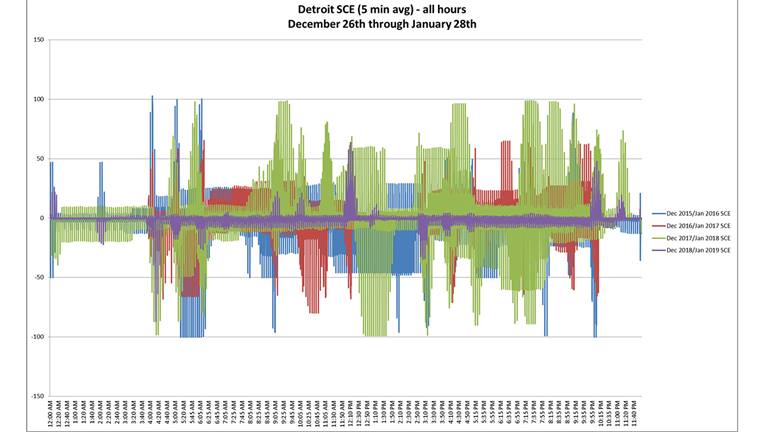
The new processes have been in place since January and, as seen in the graph, SCE variance in January was greatly reduced compared to prior years. This improvement more closely aligns scheduled generation with actual generation which means fewer adjustments need to be coordinated for the rest of the system.

The Detroit pilot demonstrates what can be accomplished through collaboration and creativity. As Tim Ernster, Detroit Operations and Maintenance Manager, put it, “[the pilot] has been satisfying because we know how we can contribute to addressing budget constraints through our operations.”

Moving forward, the BPA team is performing SCE data analysis on the entire non-big 10 system to study locations, magnitudes and frequencies of the SCE. Based on the results, BPA will expand the pilot to all non-big10 projects to use MW as the standard scheduling unit, define acceptable SCE limits, improve scheduling and operating processes, and improve communications among the parties. For certain projects BPA will also replace emails, faxes and phone calls with a web-based scheduling portal for submitting and updating generation schedules. This change will improve data transmission efficiency while reducing human error.

Looking forward, BPA is striving to establish EIM-compatible systems that meet market participation requirements in case we decide to join the EIM. BPA also seeks to improve visibility and accuracy of current and future generation capacity and to better manage energy reserves. This effort supports BPA’s strategic goals of modernizing system assets and system operations, providing competitive products and services, and to meet customer needs more efficiently and responsively. The broader objectives regarding improvements to scheduling and operations are covered in the Federal Dispatch and Generation Data Modernization project under Grid Modernization
Grid Mod: Dialing in hydroelectric generators’ responses to market signals
The purple bars on this graph show the successful reduction of station control error at the Detroit hydroelectric project over the course of the pilot study. 

How would a non-participating hydroelectric resource impact the Energy Imbalance Market?

Even though non big-10 resources (federal hydroelectric facilities not on the mainstem Columbia or Snake rivers) would not participate directly in an EIM, they would still be subject to EIM settlements, resulting in debits or credits to true up differences between scheduled and actual generation.

Under the proposed EIM model, when BPA submits its base schedule for the non big-10 resources to the California Independent System Operator, the expectation is the exact amount of generation scheduled would equal the actual production. If there is any imbalance, or deviation from the schedule, a debit or credit would result. However, to compensate for the generation difference the EIM must make an adjustment elsewhere on the system to accommodate the difference.

Just as with the non-participating resources, this adjustment could also result in a debit or credit but the financial impact cannot be predicted ahead of time. Ultimately, reducing error in scheduled versus actual generation improves predictability and performance in the EIM for BPA.


Related News

Sunrise with tower

BPA joins Western Energy Imbalance Market

The Bonneville Power Administration joined the Western Energy Imbalance Market today, enabling another tool for marketing surplus power from the Federal Columbia River Power System.