Powering prosperity in the Northwest

BPA brought affordable hydropower to all corners of the Pacific Northwest and built a legacy as one of the nation’s most affordable and reliable power providers.  

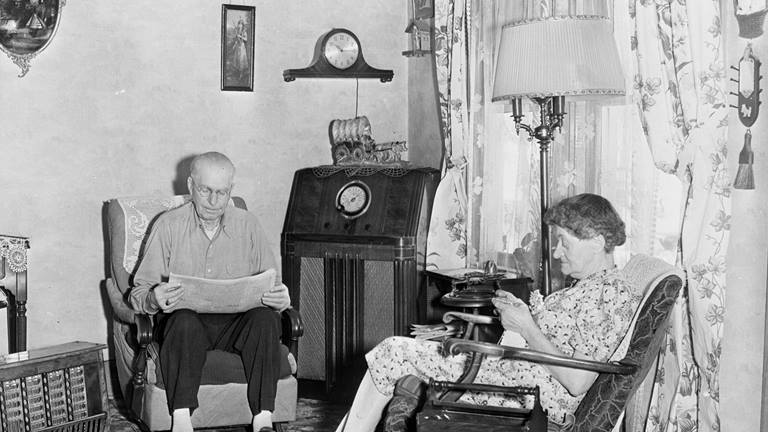
picture of an older man and woman sitting in a living room, enjoying electric appliances like the radio

Connecting rural communities

In 1937, electricity in the Pacific Northwest was largely limited to cities and towns, leaving farms and rural areas in the dark. Private power providers were not willing to invest in assets that served only a few scattered users. Upon its creation, BPA quickly got to work, pursuing its mission to broadly distribute the benefits of federal hydropower. The transmission system had to be designed, rights-of-way secured and construction crews trained – and BPA did it all with amazing speed. Between 1938 and 1945, BPA built 3,000 circuit miles of transmission lines, and by 1950 its grid had become the largest in the nation at more than 4,000 miles. Today, BPA’s grid is 15,000 miles and still growing.  

BPA is born

President Franklin D. Roosevelt created the Bonneville Power Administration when he signed the Bonneville Project Act on Aug. 20, 1937. The Act answered the question of who would control the transmission system and sell the power that federal Columbia River dams, under construction at the time, would eventually generate. BPA was founded on Roosevelt’s belief that natural resources, like the mighty Columbia, should be put to the “highest and best” use in service of the public; and that electricity is an agent of social change. With access to BPA power – sold at cost, not for profit – residential consumers paid some of the lowest rates in the nation, and the Northwest’s economy began to flourish. 

Electricity for everyone: BPA adopts first “postage stamp” rate

Before it could sell power, BPA had to develop a rate structure. The one it adopted – postage stamp rates – would become the model for future federal power systems. Just like letters delivered by the U.S. Postal Service, BPA would deliver the power at a fixed rate, no matter how far it needed to travel. The alternative rate structure, preferred by private utilities, was based on the distance the power traveled, to account for the cost of transmission. In adopting postage stamp rates, BPA fulfilled its mandate to extend the benefits of the system and encourage the equitable distribution of electric energy, spurring the region’s industrial and economic development. 

Grand Coulee Dam roars to life

While BPA’s namesake, Bonneville Dam, was the first project on the Columbia River to generate power, Grand Coulee Dam made the biggest splash when it began operating in 1933. As the largest power plant of any kind in the U.S., Grand Coulee is known as the crown jewel of the Pacific Northwest. It is also one of the largest concrete structures in the world, and its construction – which put thousands to work during the Great Depression – is considered a monumental feat of engineering. 

Public power flourishes

“Public power is for service; private power is for profit.” – J.D. Ross, BPA’s first administrator

BPA’s creation made public power possible in the Northwest. From its earliest days, BPA worked with the Rural Electrification Association, encouraging citizens to form electric cooperatives and public utility districts. Within three years, more than 30 public utilities had been formed in Washington, Oregon and Idaho serving more than 40,000 customers in rural communities and on farms. These public providers, assured of stable, low-cost power from BPA, helped temper costs for customers of private utilities by encouraging competition.

Standing up to an eruption

Mount St. Helens erupted in 1980, taking almost everything in its path. But BPA’s high-voltage transmission system stood strong. BPA crews worked around the clock dusting, blowing and washing ash from transmission equipment. There wasn’t a single outage, and no equipment was damaged – a tribute to the reliability and resilience of this tremendous public resource.

Bringing the Northwest into the digital age

In the early 1990s, communication companies couldn’t afford to run fiber cable to small towns, which left rural communities without internet. That changed when BPA transitioned from microwave technology to fiber optics for its own communication purposes – to improve how it monitors, protects and controls the grid. Because it’s far cheaper to install additional cable in the first place than to add more later, BPA routinely installed more than enough to meet its current needs and proposed leasing the excess to local utilities. The idea stalled in the face of opposition, but eventually BPA received approval from the White House and moved forward with its fiber optic program in the early 2000s.

Catastrophe averted

On a cold February day in 1996, Columbia River flooding threatened Portland with seven feet of water. While most people were unaware of the risk coming down the river, BPA and the Bureau of Reclamation worked to shut off flows from Grand Coulee Dam, storing as much water as possible in its reservoir. To replace the lost hydropower, BPA made 100 power purchases in six hours to ensure it could serve its customers, keep the lights on and help spare Portland from a watery onslaught.

The backbone of the power system: A sheet of paper?

Federal hydropower dams and transmission lines are often considered the backbone of the Northwest’s power system, but it's sheets of paper – long-term power sales contracts – that really provide the stable foundation on which the system operates. BPA has offered long-term contracts, for up to 20 years, to its customers for most of its history. Through these commitments, utilities are assured a firm supply of wholesale power, and BPA is assured its ability to recover costs. This long-term certainty supports regional economic stability and helps ensure a more reliable and affordable power supply for the communities BPA serves.

A future for nuclear energy

The region’s only nuclear plant is getting an upgrade. In 2025, BPA and its generating partner Energy Northwest announced a plan to increase the capacity of the 1,200 MW plant by roughly 160 MW. That’s enough firm capacity to power about 125,000 homes. Construction will occur during Columbia’s prescheduled biennial refueling outages and will be complete in 2031/2032, strengthening the Northwest’s supply of affordable, reliable and secure energy.

Building for the next generation

For most of its history, the Federal Columbia River Power System provided more than enough energy to serve BPA’s customers. Now, in the face of growing power demands, BPA and its federal partners are revitalizing the system with plans to increase its generating capability by more than 800 megawatts. Construction on the first of these projects – the addition of a new unit at Libby Dam in Montana – began in 2024. Other projects, including new turbines at McNary and Grand Coulee dams, are expected to come online incrementally through 2044. Combined, these cost-effective upgrades represent the system’s largest capacity increase since its original construction. 

Driven to innovate

BPA blazed a trail of innovation as it sought to deliver the greatest value at the lowest cost. Its technological developments helped improve electrical transmission system design throughout the U.S. and beyond. 

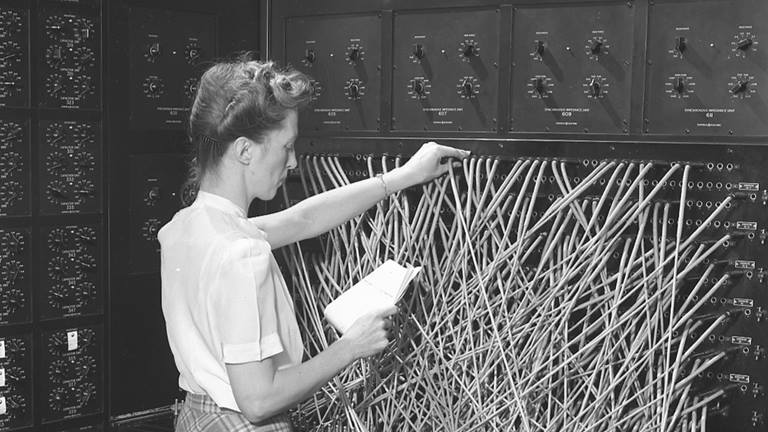
woman standing a room consumed by large computing device, holding a piece of paper while touching the computer

The computer of its day: The Network Analyzer

In the 1940s, it was the jewel of BPA’s engineering department. The Network Analyzer was an early analog computing device that took up an entire room. It allowed BPA engineers to replicate and test new additions to the transmission network before deciding whether and how to build lines. For years, BPA’s network analyzer was the only one of its kind west of Mississippi, and it proved crucial, not only to BPA’s development but to the development of the Northwest.

Dittmer Control Center: BPA enters the computer age 

In 1965, BPA announced it would centralize the control of the entire BPA network by computer. The continued manual or semi-automatic operation of BPA’s rapidly developing transmission grid and hydro generating system had reached its practical limit, and BPA knew the challenge would be compounded as the grid continued to grow. According to BPA’s administrator in 1966, David Black, “Humans simply do not have the ability to receive and digest, within tolerable time limits, the growing amount of system data necessary to make accurate decisions for power scheduling and system control.” In the process of increasing its reliance on computers for modeling, BPA established cutting-edge practices that were adopted throughout the international utility industry.

Bracing for the big one 

In 2013, BPA began testing seismic upgrades to protect transformers – the most critical pieces of equipment in the transmission system. Base-isolation technology, like what is used to protect buildings and bridges during earthquakes, separates the transformer from its foundation and uses devices to counteract shaking. BPA’s first base-isolated transformer in Vancouver, Washington, was the first in the world to use a triple-friction pendulum design. Today, BPA and other Pacific Northwest utilities use this base-isolation solution, with the intent of helping the grid withstand a subduction zone earthquake along the West Coast. A BPA structural engineer describes the innovation in a video created by The Columbian.

Getting a real-time look at grid conditions  

Imagine you are driving down the highway, but you can only open your eyes once every four seconds. That’s the view of the power grid engineers had until BPA developed phasor measurement unit (PMU) technology. PMUs sample grid conditions at a rate of several hundred times per second, giving grid operators vital data about what is occurring in real time on the system. This visibility is a major factor in preventing blackouts. In 2013, BPA earned a Platts Global Energy Award for installing the most sophisticated synchrophasor network in North America.

Tower design tool saves millions 

In 2011, BPA found a way to make transmission towers stronger, yet lighter, using less steel and less money. BPA engineers developed the Advanced Tower Analysis and Design System in-house and then made it available for use by anyone outside of BPA free of charge. The software allows engineers to economize and optimize their designs, enabling BPA to build more reliable – and more affordable – transmission lines. 

New generation of conductors carry more power

High-voltage conductors — the wires that carry energy from tower to tower — come in different sizes and designs, but typically, circular strands of aluminum wrap around a steel core. That is, until BPA engineers found a better way. In 1985, they turned the circular strands into trapezoids. With four flat sides, the redesigned strands fit more closely together. More metal remains in contact, nearly eliminating air voids within the cable. With trapezoid-shaped wires, about 20% more aluminum fits into the same cross-section. That translates into about 20% more capacity. After six years of developing and testing the idea at BPA, it quickly became an industry standard. 

World’s longest underwater cable provides power to NW island

In the 1930s Depression era, when parts of the country were ravaged by the dust bowl, the population of Washington’s San Juan Islands grew as former residents returned home to farm the fertile land. With the influx of people came a need for power. The Orcas Power and Light Cooperative, founded in 1937, installed generators that ran on diesel. These expensive generators were turned off at 10 p.m. each night to save fuel, except for special occasions, when they stayed on until midnight. Years later, as it carried out its mission to electrify remote areas, BPA set its sights on building the region’s first underwater cable. At 4.5 miles, it was longest of its kind in the world. In 1951, BPA’s new submarine cable brought hydropower to nearly 1,200 OPALCO customers 24 hours a day. This video produced by BPA tells the story of the installation. 

World’s first ultra high-voltage DC circuit breaker

In 1984, BPA led the development and testing of the world’s first extra-high voltage direct current circuit breaker. This breakthrough solved a long-standing challenge of high-voltage direct current transmission: an inability to stop the flow of power in an instant. Unlike alternating current, which breakers could easily turn off, direct current at high voltages would arc and flow across the gap. BPA’s discovery made it possible to operate long-distance, multi-terminal DC lines, with branch lines to reach surrounding areas. 

Defying laws of physics with world’s first power flow control devices

Alternating current (AC) systems aren’t very controllable – electricity follows the path of least resistance. But BPA, working with the Electric Power Research Institute, found a way to force power to go where system operators wanted it to go. BPA installed the world’s first 500-kilovolt flexible alternating-current transmission system devices, or FACTS, in the early 2000s. This technology allowed BPA to transmit more power over existing lines, a far less costly alternative to building new lines. 

National Impact

While BPA was created to serve the Northwest, its influence is felt from coast to coast. 

black and white photo showing people in an airplane factory, constructing B-17F Flying Fortress bombers at the Boeing aircraft plant in Seattle, Washington.

Powering the war effort

Although it was just a few years old at the dawn of World War II, BPA’s response to the war effort was nothing short of remarkable. It expanded the grid at an accelerated rate and increased the region’s supply of cheap, reliable hydropower, enabling the development of major shipyards, airplane plants and the aluminum industry. The Northwest produced no aluminum in 1939, but by 1944 it produced one-third of the national output. The abundant power supply also enabled the use of carbon-arc welding, an energy-intensive process that greatly sped up ship and plane building. Around this time, BPA was also directed to deliver a vast quantity of power to a “mystery load,” later revealed to be the Hanford Nuclear Works – part of the top-secret Manhattan Project. 

BPA avoids blackouts during power crisis

A power crisis in 2000-2001 created chaos up and down the West Coast. Driven by a combination of power shortages in California and market manipulation, among other factors, the crisis was both a financial and operational nightmare. Power prices, which rarely reached $30/megawatt-hour at the time, soared to nearly $2,000 at one point. While conditions were tough in the Northwest, it was worse in California, where rolling blackouts appeared imminent. BPA, fulfilling its public service role, scrambled successfully to find sufficient transmission and generation to come to California’s aid. In September 2000, the California Independent System Operator publicly thanked BPA for helping the state keep the lights on. 

The situation became worse in 2001, however, when BPA experienced the second-lowest water year on record. To avoid blackouts in its own backyard and respond to the dire need in California, BPA implemented a two-for-one power exchange that helped both regions. BPA sent electricity south during peak hours, and California sent twice as many megawatt-hours back in off hours, allowing BPA to reduce hydroelectric generation at night and store water for the following day when demand was highest. Combined with other creative actions, these power exchanges helped BPA avoid regional blackouts.

Treaty with Canada boosts power supply, reduces flood risk

In 1964, the U.S. and Canada signed the Columbia River Treaty, an international agreement that continues to deliver significant benefits to both nations. After more than 20 years of negotiations – with BPA playing a central role – the two countries agreed on a plan to construct three storage dams in Canada and one dam in the U.S. Together, these dams more than doubled the amount of reservoir storage in the basin. Water can be stored to manage flood risk, or it can be stored and released strategically to ensure steady power production. 

America’s first direct current superhighway

The Pacific Direct Current Intertie became the first and longest transmission line of its kind in the world when it was energized in 1970. Most transmission lines use alternating current, but BPA wanted to leverage the benefits of DC lines: they require two conductors instead of three, and they require simpler towers that cost less and lose less power in transit – making them ideal for long spans. Using technology BPA developed, the line starts and ends at two massive converter stations: Celilo, owned by BPA, and Sylmar, owned by the Los Angeles Department of Water and Power. Each station converts power from alternating current to direct current, or vice versa, depending on which way the power is flowing. The DC intertie had an initial capacity of about 1,400 MW, but technological advancements implemented in the 1980s nearly doubled its capacity. 

The largest electricity link in the nation

The Pacific Northwest-Pacific Southwest Intertie is a model of inter-reginal cooperation, enabling the transfer of power over long distances. This collection of high-voltage AC and DC lines has successfully distributed the benefits of low-cost hydroelectric power and balanced the economic interests of two regions. The first two AC intertie lines were built in the 1960s, with a third AC line added in 1993, not long after utilities doubled the capacity of the DC portion of the intertie. Together, these transmission lines make up the largest single electricity link in the United States.